Saturday, February 8, 2020

A Fond Farewell to Flash

Since Flash has less than a year left, I decided I should make a post about this platform that has long been very dear to me. Flash has always represented something special in that it allows very small teams or even individuals to create glorious animations and fun games that would perhaps have required whole development studios to make had Flash not existed. This lends itself very well to the world of indie gaming, which I love because small-scale projects are able to take risks that mainstream products can't afford to. When big games by big studios can start to feel stale and predictable, indie games can offer a good alternative because they feel fresh and inspired. And Flash allows these games to be hosted in a browser so you don't even have to download them, so the lack of time investment gives no reason not to try out lots of first-time games by unknown hobbyists or rising-star developers. There's no risk and nothing to lose because if you don't like a game you can happily try some other ones.

Homestar RunnerGoing back to the early days, when Tom Fulp created Newgrounds in the late 90's he really got the Flash ball rolling. Homestar Runner was also really great, and it's an example of a whole website built out of Flash, full of games and movies and just fun interactive stuff. Eventually the world of Flash gaming became an established part of the Internet. I would like to revisit some of my favorite or most memorable Flash games from over the years and say a little bit about them, so you can go ahead and try them out yourself if you like.

Ball Revamped 2
I'd like to start with the games of my friend John Cooney who is perhaps one of the most prolific game developers of all time with over 100 games under his belt. I was first introduced to John when I discovered Ball Revamped 2 (probably on addictinggames.com) and I was hooked. The Ball Revamped series is fast-paced, has a distinctive atmosphere, and is objectively way better than more modern equivalents like Flappy Bird.

Hedgehog Launch
More than just with making games, I often (wrongly) credit John with inventing entire game genres. Though Kitten Cannon was released several years earlier, when Hedgehog Launch "took off" many other launch games followed in its wake. :P

TBA++
I sometimes even say John Cooney invented achievements (even though that may not be technically true) because I remember playing TBA++ and being thrown for a loop. In addition to the cannon-to-cannon mechanic from the first TBA, this sequel had little named awards you could get for doing things that weren't directly related to beating the game. I had never seen this game mechanic before and I thought it was really cool. Of course the trend caught on and then the Xbox 360 and other gaming platforms actually built achievements into their systems and the rest is history.

Dark Cut
I often say the Dark Cut series is my favorite of John's work. Even though the games might be considered simplistic since they're just surgery games where you have to follow instructions within a time limit without making too many mistakes, at the time they pushed the boundaries of Flash games. I think Dark Cut expanded my idea of what Flash games could be about and this made it seem like anything was possible. Surgery games are somewhat common nowadays, and on a side note Amateur Surgeon by Adult Swim Games is one of my favorite Flash games of all time.

Four Second Firestorm
I have to mention the Four Second series. Perhaps inspired by Nintendo's WarioWare series, Four Second Fury was just a small collection of microgames. Then Four Second Frenzy introduced the idea of mixing together microgames created by different developers. Then finally I myself lent my talents to Four Second Firestorm as one of the many developers involved, and I cited my contribution for a long time when talking to potential employers about my experience. Years later I tried to gather game developers together for my own project, and while I didn't attract many devs I'm still very proud of that collaboration.

Sonny
Armor Games was perhaps the best place to play Flash games since they had such high standards of quality, and I'm glad to see that the website is still hosting browser games despite (most of) the games not being made with Flash anymore. Since John spent years at Armor Games, I'd like to mention some of the other devs who worked with Armor. Jakrin "Krin" Juangbhanich is best known for the Sonny series which brought role playing games to the world of Flash gaming using his own innovative game design that made the RPG feel very fresh.

IndestructoTank
Antony "The-EXP" Lavelle is the incredible creator of games like the IndestructoTank series, which is a partial inspiration for my unfinished game Jugglenaut. I'm also a big fan of his SHIFT series of puzzle games which really illustrate the value of good level design.

Light-Bot
Danny "CoolioNiato" Yaroslavski is another friend of mine, and his puzzle game Light-Bot can actually teach people programming skills. I believe it may be inspired by the Motor Programming section of The Lost Mind of Dr. Brain, and it is itself a predecessor to Danny's SpriteBox games which aim to teach coding skills to very young children. Danny was pretty young himself when his games became popular, so I see him as a sort of prodigy.

Sushi Cat
Joey Betz also made great games for Armor, such as the Pachinko-inspired Sushi Cat. I had the pleasure of meeting him at a Flash Gaming Summit in San Francisco, and I got to ask him about how he was able to implement Sushi Cat's amazing jelly physics.

Crush the Castle
I got to meet Chris "Con Artist" Condon as well, who is known for some very popular games like the Crush the Castle series (which was programmed by Joey Betz). While the game idea was itself borrowed from a game called Castle Clout (with permission), it's sometimes said to have been stolen by the billion-dollar franchise Angry Birds (without permission). Like how books can be used to cheaply test the waters to estimate whether a movie will make money, sometimes Flash games have similarly been used as tests to see what trends large game companies can make popular.

Magic Pen
Sushi Cat and Crush the Castle used an engine called Box2D which has enabled many indie developers to implement glorious physics in their games. Physics-based puzzle games became a well-established genre in the Flash world, with many great examples like Magic Pen. This game allows you to bring shapes to life by drawing anything you want and having it magically appear as a physical object in the game world.

Cargo Bridge
There has been a long tradition of bridge-building architectural simulators being used as games in addition to their practical uses. The game Cargo Bridge may not be something people should model real-life bridges after, but its fun bouncy gameplay still manages to convey a sense of how bridge physics works.

Inca Blocks
I definitely want to mention Inca Blocks since it is one of the many hidden gems of the Flash world, meaning it's far less popular than it deserves to be. Gravity gimmicks aren't uncommon in Flash games, but what's unique about Inca Blocks is that every object in the game has a different gravity vector applied to it simultaneously! Be warned: this game takes a lot of patience.

Cyclomaniacs
The developers LongAnimals and robotJAM combined to form the team Turbo Nuke, and that name was like a stamp of quality. While their games span a range of genres, they always seemed to have a thing for racing games like the physics-based Cyclomaniacs. I particularly like the bizarre Rocket Panda which may have been inspired by Star Fox.
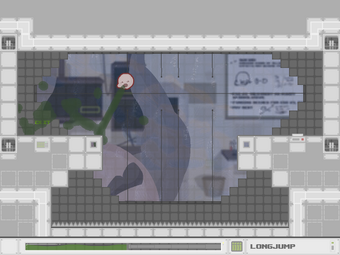
Spewer
Edmund McMillen is perhaps the most famous indie game developer of all time, and before his career really took off I enjoyed playing his Flash games like Spewer. This game features some seriously impressive liquid physics, and there are even different types of liquid that behave differently based on viscosity, etc. I've often placed it in my top three favorite Flash games.

Barbarium
While Flash games once stuck to genres that lent themselves to small and short "bite-sized" games, as the world of Flash gaming matured I started seeing bigger and more ambitious ones being released. Barbarium is an example of an adventure platformer, commonly referred to as the Metroidvania genre because of the Metroid and Castlevania franchises. These non-linear games involve exploration and backtracking as you gain new abilities, so they're hardly "coffee break" games for casual gamers.
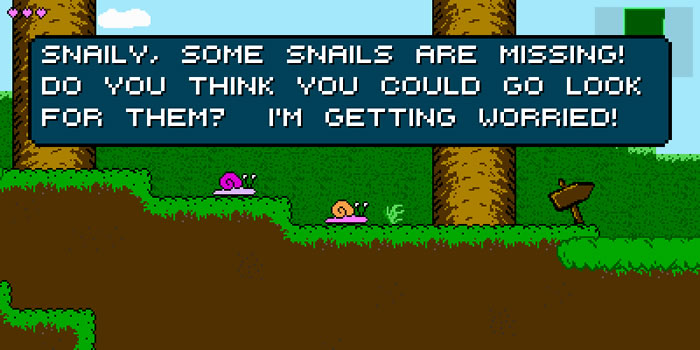
Snailiad
While adventure platformers may take on grandiose proportions, they sometimes feature very small heroes. Snailiad is a charming game of incredible quality, and yet it seems to be this developer's first and only game. I'm certainly impressed and glad they decided to dip their toes into Flash game development.

Phoenotopia
I don't want to throw around the word "epic" too much, but Phoenotopia is a game of truly epic proportions (by Flash game standards anyway). It seems the developers were inspired by console games like The Legend of Zelda, and they wanted to make a side-scrolling version of the classic action adventure genre. It's like Zelda 2 but prettier and more fun.

Wilt: The Last Blossom
Wilt: The Last Blossom is also pretty in its own way, but it's set in a rotten post-apocalyptic world where all plant life has nearly gone extinct. This game is not only masterful in its game design, but also in its soundtrack and the poetic nature of its story.
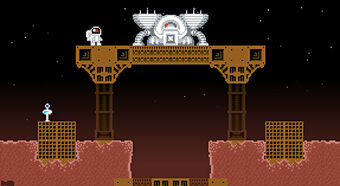
Redder
Redder is special among adventure platformers in that you don't accumulate new abilities as you play. This game has its own ways of making you explore the whole map in order to eventually reach the game's mind-boggling conclusion, a conclusion that perhaps invokes sci-fi classics like 2001: A Space Odyssey.
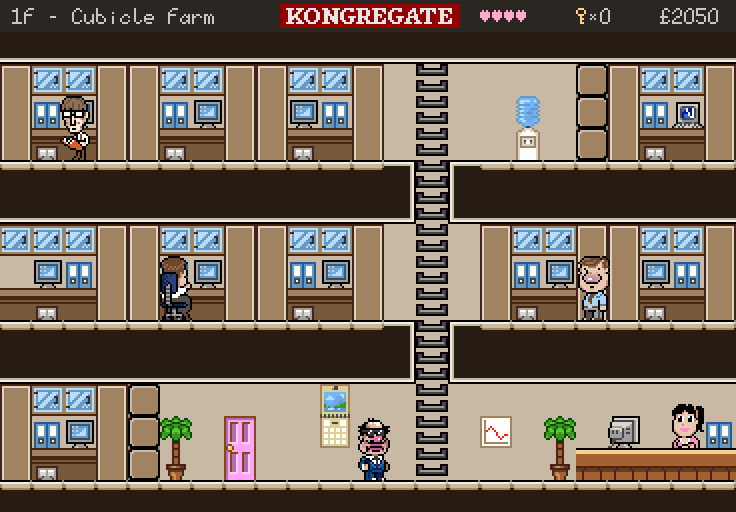
Clarence's Big Chance
Since all the adventure platformers I selected just happened to have "pixel graphics" (the old-school low-resolution enlarged-pixel aesthetic meant to resemble classic game consoles or DOS games), you may be noticing that pixel graphics are not uncommon in the Flash world despite Flash's original purpose being to facilitate vector graphics. Clarence's Big Chance is another great example of an excellent pixel game, and the creator Pseudolonewolf is also known for bringing classic JRPG's to the Flash world with MARDEK.

Dino Run
When I try to think of my all-time favorite Flash games, I usually put Dino Run at the top of the list. It is fast-paced, doesn't take long to play, has exploration/collection mechanics and beautiful pixel graphics, and is just generally a fun and fine-tuned experience. While there's not much time to explore while running for your life, that's okay because the world is procedurally-generated to keep you coming back for more. Pixel Jam is also known for other immensely high-quality games like Gamma Bros (featuring lyrics that are still stuck in my head).
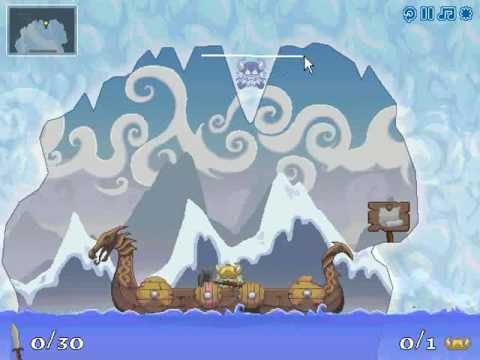
Icebreaker
Nitrome is so good at making high-quality pixel games that they're sometimes referred to as pixel wizards. Rather than sticking to familiar designs like some developers do, Nitrome always pushed its limits through innovative experimentation. Final Ninja wowed Flash gamers with its ninja star grappling hook mechanics, and Mega Mash stitched multiple games together in such a way that you can move a Tetris piece off the edge of its map and have it hop into another game world. My personal favorite Nitrome game is the physics-based puzzler Icebreaker.
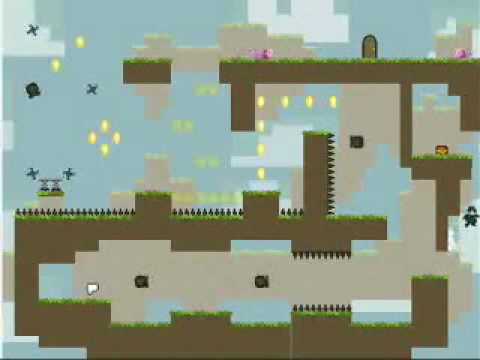
MoneySeize
If you like super-difficult platformers where you have to die thousands of times in order to beat the game, you will probably like MoneySeize. Unrelated to the actual gameplay, you may notice in this game something I call "pseudopixels." That's when developers want the best of both worlds by combining pixel graphics with transformations like scaling and rotation that are normally only suited for vector graphics. I call it pseudopixels because it's trying to mimic the aesthetic of an "8-bit" game system while featuring graphics that such a system couldn't actually render.
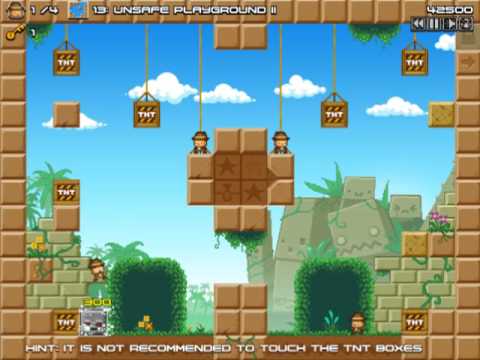
Guardian Rock
The pixel graphics of Guardian Rock are different in that the pixels aren't enlarged, but it still has a classic look and feel to it. Also the game is a lot of fun and it's a favorite of my dear older brother. The goal is simple: find a way to crush all the human invaders.

Theropods
If there's one genre that thrived in the Flash world more than any other, it might be point-and-click adventures. I love the point-and-click genre because it has a way of staying unpredictable when other genres start to feel repetitive. My friend Sarah "TinyStuffz" Duffield-Harding was inspired by her favorite LucasArts point-and-clicks like The Curse of Monkey Island, so she eventually crowdfunded the pixel game Theropods after releasing a Flash version on Newgrounds.

Gretel and Hansel
Gretel and Hansel is a Flash game with graphics made entirely with watercolor. There are supposed to be three games in the series and only two have been released at the time of this writing, with faithful fans being left in limbo forever. This is a feeling that may be familiar from many unfinished games series, Flash or otherwise. I still must recommend these creative games that I would describe as dark, disturbing, macabre, psychedelic, and certainly grim!

Hood
Another example of a twisted fairytale Flash game is Hood by Hyptosis, where you play as the Big Bad Wolf. I typically describe Hyptosis as a master storyteller, with some of his games being so story-heavy they could be considered more like visual novels. Alice is Dead may be what he's most famous for, a twisted fairytale where you play as the White Rabbit. On a side note, I feel like twisted fairytales are so ubiquitous that they're more common than non-twisted fairytales.

Submachine
Mateusz Skutnik has created many "first-person" point-and-click adventures, which are easier to make than third-person games because you don't have to animate a character walking around. One of his greatest accomplishments is the eerie Submachine series, which has many installments that build a rich and bizarre world. One of the common themes between the games in the series is that you hop between parallel dimensions, with all of them being unsettling in some way or other.
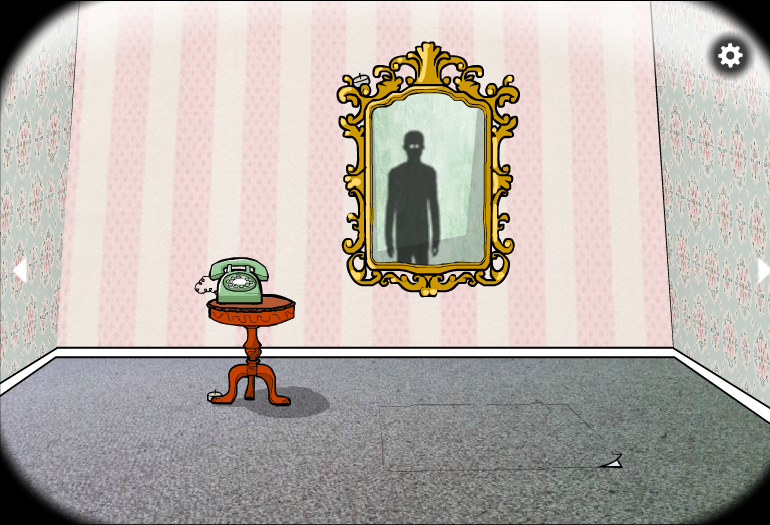
Cube Escape
Speaking of unsettling, the world of Rusty Lake may have Submachine beat when it comes to point-and-click horror. But rather than just trying to scare you, these "Cube Escape" games tend to have the effect of warping your mind. I am such a fan of these games that I make sure I play all of them, even the ones that I have to pay for. While the unique storytelling style of these games allows you to play them in any order, I tend to recommend playing the original Samsara Room first just so that it will blow your mind as much as possible, and I think it's only available as a Flash game.

Paul & Percy
Speaking of mind bending, many of my favorite games could be described as tile-based puzzle games. These games are often perfect examples of the importance of good level design, a sometimes-overlooked component of game design. The mind-bending game Paul & Percy is not nearly as popular as it deserves to be, with brilliant level design to go with the brilliant game mechanics. Apparently players were too disoriented by the sideways reflective world (perhaps bringing the upside down from Stranger Things to mind). I like this game so much that I got better scores in some levels than the builtin maximum scores, and the developers were so impressed that they wanted me to help test their iPad release.
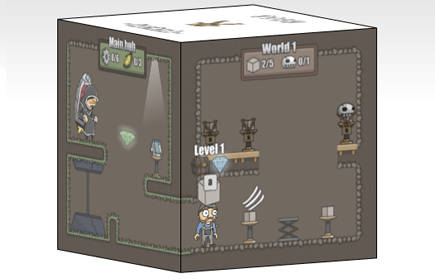
Sideomorph
Whether or not Sideomorph would be considered a tile-based puzzle game, it's certainly reality-bending. This side-scrolling puzzle game is played on the sides of a cube, which allows you to scroll in ways you never thought possible. You can walk to the cube faces to the left or the right, or you can rotate the face you're in so that the top and bottom of the cube become your new left and right. Mechanics involving 2D gameplay projected onto a 3D world can also be seen in the eye-popping Sky Island.

Frost
Speaking of unpopular games, Frost is truly exceptional despite being nearly unknown. I remember being so stumped by some of these puzzles that I was at one point convinced that the game wasn't tested to make sure it was beatable, but in truth it just involves expanding your mind a bit.

Talesworth Adventure
Talesworth Adventure may seem simple, but its sheer quality has never allowed me to forget it. I'm amazed by how much they were able to do with so little, meaning each puzzle feels so fresh and unique even though they all mostly use the same straightforward mechanics. Some levels do actually have unique elements in them, and that makes it all even better. The creator was apparently inspired by their love of tile-based D&D dungeon maps.

King Dugan's Dungeon
Without Flash I never would my discovered my favorite game franchise: Deadly Rooms of Death. I have Maurycy Zarzycki to thank for bringing to the Flash world the first game in the series: King Dugan's Dungeon. The game apparently has 25 levels and Maurycy was releasing 4-level chunks as episodes, and I believe I first came across DROD when I saw episode 3 pop up on Newgrounds. I didn't know what to think of it at first but I quickly fell in love with DROD because it has the kind of adult-level puzzles I crave while staying fun and adventurous rather than getting tedious. The final episode will probably never be released in light of Flash's demise, but being the DROD fan that I am I'll be happy to replay the levels I've already played when I get around to playing the full desktop version of King Dugan's Dungeon. I've already beaten most of the other games of course.

The Majesty of Colors
Like the rest of indie gaming, the Flash world involves what are known as "art games." While all games have art in them such as the graphics and the music, art games are special in that the games themselves strive to exist for some artistic purpose. The imaginative Gregory Weir created lots of them, like (I Fell in Love With) The Majesty of Colors about an enormous tentacled monster from the colorless deep. When the movie How to Train Your Dragon came out I remembered Gregory's How to Raise a Dragon from years earlier and thought there might be a connection, though the book How to Train Your Dragon predates Gregory's game.

400 Years
Despite being a short game, a lot of players seemed to complain about 400 Years taking too long (which is ironic considering the title). This game's unique design involves waiting for years at a time for trees and stalactites and even civilizations to grow. Perhaps more than the game itself, I remember reading a particularly funny comment that went something like this: "People are complaining that you can't move fast. You're a rock with a 400-year deadline. You don't have to move fast." It's the "you're a rock" part that gets me.
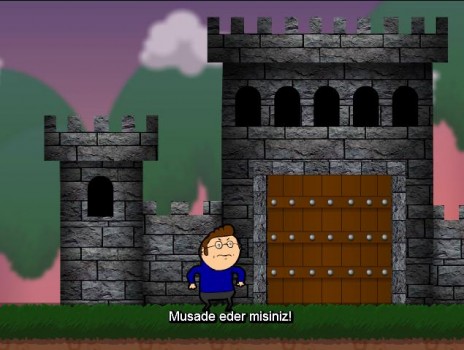
You Only Live Once
Raitendo is known both for the weirdly-catchy game Doeo and for You Only Live Once (which predates the YOLO trend that is itself now outdated). To me the best examples of video games as art always subvert some kind of established gaming tradition, and the idea behind You Only Live Once is to subvert your expectation of being able to die many times and retry the game over and over. The game uses some kind of persistent storage that remembers your death and prevents you from starting over no matter how many times you refresh the page. I did actually manage to beat the game using a hack that let me try again, but I won't reveal it here. Let's just say it involved finding the right website where the game was hosted.

As I Lay Dying!
As I Lay Dying! is a morbidly poetic autobiographical-but-not-really puzzle platformer. You play as the girlfriend of the game's deceased developer and you have to carry his heavy corpse out of the woods so that it doesn't get eaten by birds. I'm not kidding.
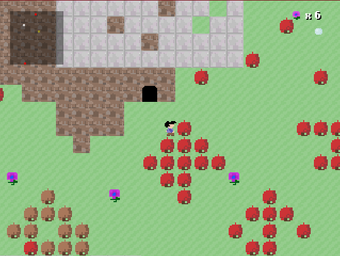
Where We Remain
Where We Remain is game with many mysteries that are open for interpretation. You are stranded on a haunted island with a rich history for you to piece together. I've sometimes thought this game would make a good movie, or at least a good fake movie trailer.

Factory Balls
I almost forgot to mention the iconically stylized games of Bart Bonte, but I was reminded when I signed into Armor Games and saw that he has just released an enhanced version of his classic puzzle game Factory Balls. I played through his whole demo and then bought the game for Android as a way of paying respect. His games are minimalistic and streamlined with fresh and delightful puzzle elements, and they're perfectly accessible to casual gamers as well.

Lucky Tower
I was once asked to recommend games that would make a good distraction, and I said "anything by Molkman." His games like Lucky Tower are as funny as they are fun, full of weird animations and dialogue. Molkman is truly a Flash legend in my mind.

Ge.Ne.Sis
Wanting to talk about the forgotten game Ge.Ne.Sis was surely a major motivator for this post. Ge.Ne.Sis is a unique tactical RPG with a deeply fleshed-out story. All of the art in the game clearly had a lot of love put into it and one of the features that stuck out to me was that the soundtrack is comprised of full-length songs, some of them upwards of five minutes. It's normal for a track in a Flash game to be a 30-second loop with some variation depending on how much time the player is expected to spend in the part of the game where the song is playing, so a main gameplay track will be longer than a menu track. But in Ge.Ne.Sis you can just sit there and wait and the music will keep changing and flowing into new themes without repeating itself for a long time.

GemCraft
GemCraft is certainly not a forgotten game but the first chapter is titled "The Forgotten." Since you can combine gems to blend their colors and powers together, I commented that something special should happen if you combine all eight colors into one gem. I don't know if the developer heard me or not, but the next game contained a special prismatic gem that you make by combining the others like I described. So there were eight colors plus a ninth combined color, much like the borders I've applied to the boxes on this page. I probably don't need to explain how much the tower defense genre thrived in the Flash world. Other tower defense games I like include the genre-redefining Kingdom Rush, and when it won all the awards at the Flash Gaming Summit I was there to see the developers nervously say they were each worse at speaking English than the previous one even though they spoke English fine and it was cute. I also like Protector: Reclaiming the Throne because the levels are so finely tuned that it's like a puzzle game where you have to figure out each special solution.

Blue Rabbit's Climate Chaos
I'm happy to pick Blue Rabbit's Climate Chaos by The Super Flash Bros. as the final game for my list because it's another one of my all-time favorite Flash games. This game is a marvel for many reasons, like bringing 3D gameplay to the Flash world in a time when no one else was. One of the game's defining qualities is that it uses its own language to communicate with the player. The characters talk in gibberish and symbols so that the point can get across regardless of whatever languages that the player happens to speak. When I looked up this game to link to it for this post, I came across a recent comment from someone who said they remembered playing the game as a child because it was one of the few games available to them as someone who couldn't read English at the time, and that warmed my heart.

Thank you for reading my post! I felt the need to write this because of how much Flash games still mean to me. If you feel like there are specific games that should be on this list then I'd probably agree with you. The games I picked and the people I chose are largely arbitrary, but I felt that I had to make arbitrary decisions about what to include or else this post would never get written and then it would be too late before I knew it. I picked the games I picked and I credited the people I credited because they mean something special to me or because I want more people to know about them or because they do a good job of showcasing the world of Flash gaming.

I recall occasions when people like me would express concern that Flash was going to die soon, and there would be snarky responses about how we could always use some kind of emulator if we really wanted to play Bloons. I have nothing against Bloons of course, but in this case it was being used to diminish the rich world of Flash gaming. So part of my motivation for making this post was to prove to the ignorant just how much value is being lost because of the decision to discontinue Flash support. It's not just a few frivolous lightweight coffee-break games for kids, it's a whole ecosystem built by many of the most creative people in the world.

If you'd like another sort of postmortem of Flash games, John Cooney actually did an hour-long talk about this at GDC back in 2017. Thank you again, and may Flash live on in our hearts forever <3

~ Kyle Delaney

Saturday, December 21, 2019

Marginalized groups can portray themselves

Penn Jillette does a podcast called Penn's Sunday School and his latest guest was Sam Harris. These two rich and famous atheists belong to some very privileged groups, and yet they found it appropriate to validate each other's opinions on the topic of cultural appropriation. Penn talked about actors like Scarlett Johansson portraying characters of different races, orientations, etc. as being in the same vein as authors writing characters similarly outside of their own experiences. He said acting is all about playing someone different from yourself, and if you're only allowed to play someone just like you then there's no point. Likewise, if authors weren't allowed to speak for people who are different from them then all writing would have to be memoir. He said the desire to portray someone else should be considered the highest compliment.
It may be true that acting and writing have some important similarities. They both involve extensive research, for example. But one very important difference is that an author does not have to physically embody the characters they write.
I know the topic of cultural appropriation has long been a major point of confusion for a lot of people, maybe even most people, especially when it comes to the distinction between appropriation and appreciation. I've come to understand it like this. Appreciation is saying "I like that." Appropriation is saying "I like that. It's mine now."
I want to explain a little about my personal journey. As an actor myself, I often viewed the paradigm of cis actors playing trans characters as something very innocent and normalized. I'd see movies like "Transamerica" and "The Adventures of Priscilla, Queen of the Desert" and I'd love them. To this day I have to admit that they contributed to my positive feelings towards trans people. I saw the idea of playing a trans person as being this sort of ultimate acting challenge that I might have to take on someday. It never occurred to me to wonder why I didn't see trans actors playing trans characters, and it may not have occurred to many casting directors to wonder that either.
Once upon a time, all characters had to be portrayed by men onstage whether those characters were men or women. While whitewashing in film remains a problem to this day, in the early days of film it was considered a necessity for white actors to portray nonwhite characters. When actress Maysoon Zayid was studying theatre at ASU she got excited when the school decided to put on a production of "And They Dance Real Slow in Jackson" which is about a physically disabled woman, and to her dismay the school cast an able-bodied student in the role. I believe these phenomena are connected, and I believe I know the reason for them.
Maysoon Zayid
Maysoon Zayid was offered the explanation that the school did not believe she was able to do the stunts in the show, to which she replied that if she couldn't do the stunts then neither could the character. I suspect the school's justification for discriminating against Maysoon is similar to the reasons for all such cases of discrimination. The majority believes the minority cannot be entrusted with the task of portraying themselves because the minority is always deficient in some way. At best it's a matter of them "not being able to perform the stunts," and at worst it's a matter of them not being considered fully human.
At some point I was forced to examine the question of why trans characters had to be played by cis actors, and I realized that it's because trans people were so othered by society that the very idea of trans actors was barely thinkable. Trans people were some strange anomaly to be observed and marveled at, not ordinary people that you can talk to and be friends with and invite to a casting call. I know that great progress has been made in the recent past but there's still a long way to go now and I feel like public consciousness was so much worse even just 5 years ago. And the more I think about this, the more I realize that this was about more than just trans people and more than just acting.
This whole pattern also reflects the infantilization of autistic people. All the attention that the mainstream media gives to autism is about autistic children, but the subtext is that it's really about the non-autistic parents of autistic children. The narrative is told as though autistic adults don't even exist because they want you to believe that non-autistic people are the gatekeeping experts on autism and the existence of autistic adults would supplant that. Of course everyone intuitively knows that autistic adults must in fact exist and they're even getting written as characters on TV and in movies, but the prevalence of non-autistic actors playing autistic characters sends a clear message that autistic adults cannot be capably engaged with as fully functional human beings.
Despite all their experience and expertise, I think people like Penn Jillette and Sam Harris are ultimately ignorant of the perspectives of these kinds of marginalized groups. Atheists may be marginalized but they've never been marginalized in way that takes the form of a widespread belief that you can't even be given the responsibility of portraying yourself. This might go without saying, but I no longer aspire to play a trans person and it's not because I'm no longer pursuing an acting career. When you're only thinking about widening your repertoire as far as possible then you're forgetting the other side of it, the people who aren't getting the roles you're taking. It's not about telling a privileged actor they can't play a role, it's about telling a marginalized actor they can.

Monday, May 7, 2018

Marvel Spoilers

I've seen a lot of movies. There was a time in my life when I watched a movie in the theater every week, and I'd be watching movies at home every day. I transformed from an average moviegoer to an avid critic, but then I moved past the critic phase and decided most of my old critiques just don't even matter. It may be a worthwhile pastime to nitpick a film's technical qualities as a profession or a hobby, but I'd rather sit back and enjoy a movie for what it is and appreciate the work that hundreds of people put into it, much like the average moviegoer I once was. So in that sense I've come full circle.

I still do like to critique, but I began to think less in terms of what the movie is and more in terms of what the movie represents. My critiques grew past the confines of the movie itself and expanded into the movie's context, the place the movie has in the world and the effect it has on our culture. When I talk about "good" movies now I don't mean technically competent movies so much as movies that do good. A movie is good if it's a good thing the movie exists.

So this is not exactly a review of Avengers: Infinity War but rather a review of Hollywood and movies in general. There are of course many things to say in a conventional review about the movie, all about how the movie made us feel and how we laughed at these moments and cried at these moments and liked certain characters or didn't like certain characters, but that's all been said and it's not what I want to say. I'd rather talk about what the movie teaches us, either consciously or subconsciously.

When it comes to a movie or really any kind of story, it's important to ask what it's about. What is the meaning behind it? What is it trying to say? What is the message? The moral? Does it have one? Does it even have a point at all? Sometimes it seems like writers skip that part, or decide the movie needs to say something so they draw a meaning out of a hat. That's how movies end up being about really safe things like the importance of friendship and working together, themes that don't really challenge our preconceived notions at all. A movie like Infinity War specifically needed to appeal to as many people as possible to sell as many tickets as possible on a global scale so it couldn't afford to take ideological risks. Is it just an emotional action adventure movie about witty likable characters or does it have some meaning beyond that?

I love Lord of the Rings. I don't think there's a single movie that can top how many times I've seen the Lord of the Rings trilogy. And seeing how it's based on a classic work of literature, I've spent many years trying to extract some kind of meaning from it. Some people say it's about the rise of technology and industry threatening a more peaceful and humble and natural way of living, but most examinations reveal it to just be a fun fantasy adventure with little or no point beyond that. Then I heard about a Lord of the Rings spin-off where Sauron was a freedom fighter and it made a lot of sense to me, and I started seeing Lord of the Rings in a different light when I watched the movies.

Sauron was forced to live in the crappiest place in the world. Everyone else got green pastures and blue skies, but the orcs were walled into this ghetto and were killed whenever they tried to leave. In the movies we see the forces of Mordor portrayed as the warmongers, always slaughtering innocents, but isn't that what you'd expect to see if history is written by the victors? We see men and elves and dwarves portrayed as brave heroes and they often refer to Mordor as just "the enemy." Isn't that nationalistic pro-war language? Grima and Denethor suggested that the heroes shouldn't be fighting, and they're portrayed as slimy traitors. Can you perhaps imagine a real-life equivalent of Lord of the Rings happening a totally different way in reality but then being presented in the media and the history books as something more like the Peter Jackson films?

I know this little tangent sounds awfully silly to someone who hasn't thought along those lines before, but that's part of my point. We've been watching movies like this all our lives only seeing them one way, oblivious to the effects they may be having on our psyches: the subconscious sources of all of our opinions on everything. There is no part of me that believes Peter Jackson actually intended Lord of the Rings as pro-war propaganda, but that's also part of my point. When a filmmaker isn't entirely sure what they want to say with a movie their subconscious biases derived from the status quo and their own lifetime of movie-going creep into the movie they're making, and then get transferred to the subconscious minds of the audience. I don't believe Joss Whedon intended Firefly as support for the Civil War Confederacy and I don't believe its fans interpret it that way, but there it is.

If you don't think movies are really affecting your entire worldview on a deeply subconscious level, ask yourself this. Do you think in terms of good and evil? Do you think there is such a thing as good and evil or good guys and bad guys? Do you think there are villains out there that brave heroes need to defeat? Do you think violence is necessary to achieve peace? Is peace even your goal? Is violence ever necessary?

These aren't incredibly outlandish ideas, and I'm not saying any given answer to any of those questions is necessarily wrong. My point is that it's largely movies that are informing our answers to those questions, and they're mostly doing it without you being aware of it and without the movies themselves even trying to. The idea that there is such a thing as a bad guy is a deeply ingrained part of both our psyches and our culture and there are real-life consequences when it comes to how willing a nation is to dehumanize other nations and go to war. Before we can think differently about that we first need to realize that another way of thinking even exists. We need to imagine what we might be thinking if we never saw any of these movies or read any of these books and had instead read books and watched movies where there weren't any villains and the conflicts were internal.

You might be skeptical of Hollywood's capacity to make movies that don't have villains. Indeed, Aristotle seemed to think of antagonists as a necessity. Inside Out comes to mind as a movie where all the conflict is internal if you'll forgive my double-meaning. But again, I digress.

Infinity War is an incredibly popular movie. There was a local 18-screen theater that was playing it on 12 screens. When I went to a second-weekend matinee, the theater was packed. It made a billion dollars in the first 11 days.

What is Infinity War about? Well it's a Marvel movie, so you can expect plenty of violence. Somehow we don't think of these movies as movies about violence. We think of all the heroics and kind of forget the violence, and that's kind of my point. When we talk about becoming desensitized to violence, maybe it's more than just the toughening of our guts so we aren't horrified by torture and don't faint anymore when we see blood. Maybe it's that violence is so normalized and expected that we don't even think of it as violence anymore. It's just what the heroes gotta do to win.

Thanos is what I call a complex villain, and when I explain what I mean by this I always use Babylon 5 as an example. The Shadows are a boring villain because they're defined as just pure evil and there's really no motivation to their actions beyond that. The Centauri on the other hand should know better. That's why the Shadows are a basic villain and the Centauri are a complex villain.

Thanos has a heart. He believes he's doing the right thing to save everyone, and not once does anyone ever try to reason or negotiate with him. Our heroes, the people the audience is being told are the good guys, immediately resort to violence and never even try anything else. They punch and stab and shoot and when that doesn't work they punch and stab and shoot some more. Even Doctor Strange, the unconventional fighter who defeated evil using his wits in his own movie, contributes by hurling fireballs. Avengers: Infinity War is the story of the greatest doom the Marvel universe has ever faced, but why is it so dire? Why is everyone so doomed? Because, as is continuously proven to us again and again over the span of a few hours, Thanos is too powerful to be defeated by brute force. That's why we're all doomed.

"But wait!" you say. "Surely violence is needed in real life when faced with violent enemies." Well maybe, but is it the solution every time? Is it really plausible that violence is needed so often that we should just assume there's no other way in every situation? Is the trope of there being no alternative to violence in movie after movie really an accurate reflection of reality?

"But wait!" you say. "Our heroes knew intuitively that Thanos couldn't be reasoned with so they didn't want to waste precious time." Why, because he's a big bad villain? Thanos wanted balance, so why not ask him if having all the power in the universe really seems like balance? Why not appeal to his desire to end suffering when trying to get him to stop torturing people? If I were reasoning with Thanos, I'd ask him to use his time stone to look into the future he was making and see if it was really what he wanted. I saw a post on Facebook making Thanos look like an idiot for using his unlimited power to reduce the number of people rather than just increasing the number of resources. And to be clear, I'm not saying any of this would work. But when a movie is full of people we're calling heroes who have powers that are all about winning fights and battles and wars, and these heroes shoot first and ask questions later, that means something.

Consider Star Trek: The Next Generation. The crew of the Enterprise encounters god-beings that they're no match for, but is all hope lost? Of course not, because when faced with a seemingly impossible situation where a hostile omnipotent enemy gives you an ultimatum there's no way out of, the Enterprise crew members put their heads together and come up with some kind of intelligent peaceful solution. Compare that with Guardians of the Galaxy Vol. 2. Those heroes faced off with a god and rectified the situation by blowing it up.

And what are these Marvel heroes even fighting for? There seems to be a trope where complex villains are always fighting for change, which means the heroes must necessarily be fighting for the status quo. The villains have clearly thought this through way more than the heroes have. Much like the villain in Dan Brown's Inferno, Thanos is trying to address the ongoing problem of overpopulation. Thanos wants to end suffering and the heroes are doing everything they can to stop him from doing that. What does it say about the movie industry and the audience and our culture when the best thing we can come up with to villainize is a heartfelt attempt to make the universe a better place? What does it say about us when we hear a call for change as a call to arms and we fight to the bitter end to make sure things stay the same? Beat the bad guys, offer no alternative solutions to the problem they were trying to solve, and rest easy now that there aren't any villains out there to remind you of that problem.

I know Infinity War is just a popcorn movie made to sell tickets and let the audience have a good movie-going experience. It would be fair to say that I'm reading too much into it if my claim were that the filmmakers intended all these effects. But again, what I'm saying is that the filmmakers don't intend these messages any more than the audience interprets them, but they're there all the same. It's just a matter of thinking a little harder about what a movie represents and what it's saying whether it means to say that or not.

Sunday, December 31, 2017

Everything wrong with that one episode of Discovery

Star Trek: Discovery. Season One. Episode 7. Magic to Make the Sanest Man Go Mad.

If the idea was to make us go mad as the episode title suggests, I think it accomplished its goal.

On some level I have to acknowledge that the episode really was trying to make the audience angry, and so a lot of my anger is a point in the writers' favor and not against them. But if you're going to make your audience feel bad then you have to earn it. You can't just make them feel bad for no reason.

With an episode that goes around in circles so much, where do I even start?

The last time we saw Harry Mudd, he was a helpless prisoner. If he had some means of escaping then it's curious why he hadn't done it already. And not only did he escape, but in a few days he managed to become the most powerful man in the galaxy, a supervillain mastermind capable of the impossible by virtue of unknown technology.

Logically, every person aboard the Discovery should have been smarter than Mudd because they had undergone Starfleet training. Mudd was a smart guy in a business sense, but he wasn't exactly doing "business" in this episode. He was doing action hero secret agent hacker stuff, and more for the purpose of hateful vengeance than profit.

The idea was that Mudd was getting more and more competent with each iteration because he was learning more each time and was able to avoid past mistakes. There are a few problems with this. For one thing it doesn't matter if you know how to avoid mistakes if what you're trying to do is impossible. And some guy taking over a Federation starship with the entire crew still on board should be impossible. But near-instantaneous single-handed complete takeovers have practically become a stale sci-fi trope at this point, and with their frequency you'd think these people don't plan any sort of system security at all.

With the odds Mudd was up against there should have been many times more failures than successes with every little thing he was trying to do, but we weren't really shown the failures. The episode gives the impression that he accomplished everything sort of quickly and that just adds to audience frustration. He fails quickly the first time (after killing a half-dozen mysteriously-unarmed crew members), but after that he immediately accelerates all the way to his major blocker: operating the spore drive. And from our perspective, that's the only obstacle he has to get past by looping over and over again. We never even saw an iteration where they didn't take the gormagander on board, despite the time loop conveniently starting before that event. If they just kept Mudd off the ship then that would have significantly slowed the speed at which he could gather information.

Another huge reason Mudd should never have gotten so far is that Stamets had the same advantage Mudd did, so he should have been learning to counteract Mudd at least as quickly as Mudd was learning to advance. But for some reason while Mudd was busy gathering all of Federation knowledge in his unremarkable head, Stamets was throwing himself against a brick wall by futilely trying to get people to believe him over and over again. Mudd's goal should have been impossible regardless of the amount of iterations. The crew even acknowledges at the end that there may be no way to win no matter how many times you do it over, but they said it about themselves and not Mudd.

The writers did a double twist at the end, where they said Mudd really didn't want to reunite with Stella but then oh wait he did! So our heroes conned the con man but then actually got conned with their own con. It's an extra dissatisfaction to see this evil psychopath live happily ever after with the woman of his dreams. Perhaps the show is counting on the audience knowing that in the original series Mudd became unhappy with his marriage.

But the original series Mudd is so very different. He was a comical villain and comical punishments were appropriate. You don't really even hate him, because his foibles gave him a certain charm. Rainn Wilson's Mudd is so much more malicious, and yet the end of the episode treats him like the goofy old villain from the original series, like we're supposed to be okay with someone who happily tortures people to death getting to run away with the love of his life. He had demonstrated both the will and the means to destroy the entire Federation, and the crew seemed perfectly happy to let him slip through their grasp, saying he should be kept "out of their way." Mudd was in their way? That's an odd euphemism for someone who was both trying to and succeeding in torturing and killing everyone.

I think the episode may have landed better if Mudd was written as someone who just wanted to make a profit off of stealing the ship, and the Discovery was selected because of its value to the Klingons while the bad blood from recent events made Mudd more comfortable sealing the crew's fate. Maybe that Mudd could have been reasoned with as someone who didn't really want to see the entire Federation fall. As it was, Mudd's insane quest for revenge seemed to be going a little far.

EDIT: I just remembered something else. In not one of the iterations do we see anyone killing Mudd! Clearly that wouldn't have stopped him because he died in the explosions, but it would have at least slowed him down and it would have made sense to try it from the crew's perspective. Maybe it's because the Federation is so "peaceful" (even though that's been turned on its head in this series), but someone could have at least mentioned the idea!

Monday, January 25, 2016

Theatrical Blocking Shorthand Code for Actors and Directors

Click here to download my cheat sheet in PDF format.The first page is the cheat sheet itself and the second page is examples. You can print the examples on the back of the cheat sheet if you like. It's designed to be somewhat intuitive, so reading the explanations in this post is optional. Use and modify the code to your personal taste.
The code itself only uses six letters, which frees up the rest of the alphabet to be used as code letters for specific things or people. You should be familiar with what these letters mean, but here they are just in case: X means cross, C means center stage, D means downstage, U means upstage, L means stage left, and R means stage right.

Fixed crosses:
These are what you should all be familiar with. They're probably the most universal blocking shorthand, and I think for most actors they're the only real code they use at all. They're called fixed crosses because they're for when you're supposed to cross to one of 15 specific spots on the stage, regardless of where you're crossing from.

Relative crosses:
A relative cross is when you indicate which direction you move from your current position. If you just write XDL, that means you cross all the way to downstage left, but if you write XDL, that means you just move downstage left from where you are now. Maybe you won't go all the way to downstage left, or maybe you already are downstage left and you go even further in that direction, perhaps moving off the stage. Relative crosses are useful for when you just move a little rather than making a full cross, or for when you know that even if your blocking changes so that you'll be standing somewhere else, you'll still be moving in the same direction. In the examples, you'll see that you can use a subscript numeral to indicate a specific number of steps, but I didn't end up fitting that onto the cheat sheet.

Relative locations:
"R/object" means "R of object." I found myself writing "of" so often when I was supposed to cross upstage of the table or stand stage left of my scene partner that I shortened it to "o'table" kind of like "o'clock," but that was still too inefficient. So now it's just one stroke. On the cheat sheet, there's a circle in the middle of eight locations that are all defined relative to the circle. I use a circle to mean another actor onstage, but here it's just an example, meaning you can use relative locations with anything and not just actors.

Partial crosses:
The hyphen means in between, so a partial cross is when you cross towards something but don't go all the way there. You cross to a point in between your current location and your destination.

In-between locations:
You can use a hyphen to indicate a spot between any two things, not just between yourself and your destination. For example, suppose you're directed to stand in the window between two other actors. You can write XU/Jack-Jill.

Pathways:
Sometimes there will be more than one possible path to take during a cross. If you're crossing to the other side of a table, you'll want to write that you're supposed to go around the upstage side of the table and not the downstage side. But if you just write XU/table it will look like upstage of the table is your destination rather than the way you're supposed to get to your destination. So you'll need to use special pathway notation to clarify.

Surface positions:
A surface position is a relative location that's on top of something. If you write R/table, that looks like you mean a spot to the right of the table rather than a spot that's actually on the table. If you want to be clear that you're supposed to sit on the right edge of the table itself rather than on a chair next to the table, reverse the notation by writing table/R.

Body:
Each body part is signified by some combination of lines and circles. The body diagram is meant to illustrate how each symbol is intuitive based on its location on the body. You can use the body part symbols to indicate a variety of things, e.g. that you're supposed to put something on someone's shoulder or touch their leg or move your own hips.

Scene Partner:
The plain circle indicates just some other person on stage and should be used either when there's only one other person or when it's obvious which person you mean. When there are multiple other people, you can embellish the circle like an emoticon to indicate which one you're referring to. For example, if they wear a hat then you can put a hat on it, or you can put sunglasses on it if it's a cool character.

I think the rest of the symbols are mostly self-explanatory. Some symbols have abbreviations that you can use as an alternative. There are two types of kneeling because you could be kneeling on one knee or both. If you don't know what I mean by "counter," that's when you move just because someone else is moving and you need to even out the spacing of the actors on stage.

These are all examples of real-life stage directions I have received as an actor:
First column:
Sit in the center chair (there were three possible chairs to sit in, all in a row)
Take 3 steps in the downstage left direction (the subscript 3 indicates a number of steps and isn't on the cheat sheet)
Cross partway to the table
Enter from downstage right
Sit to the left of the table on the right (there were two tables onstage)
Face towards scene partner
Cross to scene partner
Take scene partner's downstage hand (romantic gesture)
Cross to stand upstage right of the chair

Second column:
Exit stage left after scene partner
Stand and cross to the right of scene partner
Cross to a spot upstage left of the table, taking a route above (upstage of) the table rather than below (downstage of) it
Cross to the downstage right portion of the stage, taking a route below (downstage of) the table
Move the chair in the downstage direction
Sit in the chair to the right of scene partner
Wait upstage left of the table
Sit on the stage right portion of the bench
Cross to the downstage left portion of the stage, taking a route below (downstage of) scene partner

The following are the only examples I could find of preexisting blocking codes:


Feel free to use them as you please. I find the movements that are signified by letters modified by arrows to be pretty useful, like jump and put down. I've also used the circle-around symbol. In general I think my code is superior because it's less ambiguous and uses fewer strokes, like in the symbol for "seated."

My main motivation for creating this code is that writing down blocking takes too much time and space, cluttering up your script which often has very small margins, and holding up the flow of rehearsals. Writing your blocking is often such a chore that actors simply refuse to do it in order to respect other people's time. Especially when it's a complicated or unusual direction with specifics like which route to take or which direction you should be looking, actors prefer to try to remember it rather than writing it down, which often results in the director forgetting and the direction being lost forever, or the director having to tell the actor again and again. This concise blocking shorthand eliminates those problems and makes writing down stage directions a joy instead of a burden.

Please do let me know if you get any use out of it! Thank you. :)

Simulating a chatbot in Snowsight

PREREQUISITES: A basic understanding of Snowflake, Python, and Streamlit An active Snowflake account Streamlit  comes with some  chat functi...